

What is the Content Editor?
The Content Editor (ContentHub) is the Reelevant platform’s visual design tool for building dynamic templates — banners, email sections, landing pages, and more. Using a drag-and-drop canvas, you create layouts with text, images, shapes, and data-driven components, then connect them to datasources to personalize every element at render time. Each content template is used by workflow output nodes to deliver the final visual experience to your audience.Key Concepts
Content Lifecycle
A content must be Published before it can be assigned to a visual content output node in a workflow.
Editor Layout
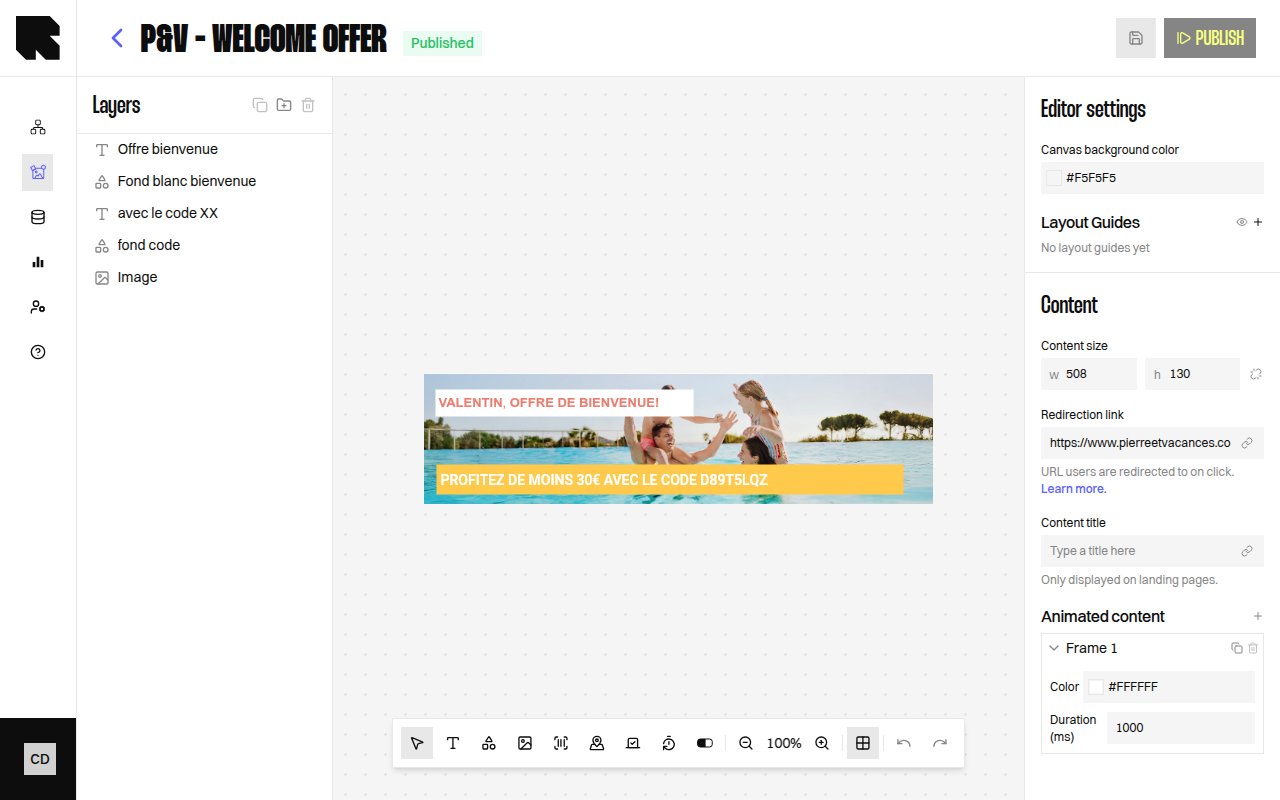
The Content Editor is organized into several areas:- Header — Displays the content name, status, and action buttons (Preview, Publish, Settings).
- Canvas — The main design area where you place and arrange components.
- Toolbar — A bar with tools for adding components (Text, Shapes, Images, Barcode, Map, Countdown, Progress bars), zoom, undo/redo, and layout guides.
- Layers panel — A tree view showing all components and their hierarchy.
- Configuration panel — Opens when a component is selected, showing its properties (position, size, appearance, data binding).
- Frame dock — A page preview carousel at the bottom for navigating between frames.
What’s Next?
Content Listing
Browse, create, and manage your content templates.
Editor
Learn the editor layout, toolbar, and canvas controls.
Components
Explore all available component types.
Layers
Organize components with the layers tree.
Data Binding
Connect your content to dynamic data sources.
Conditions
Control component visibility with data-driven rules.