

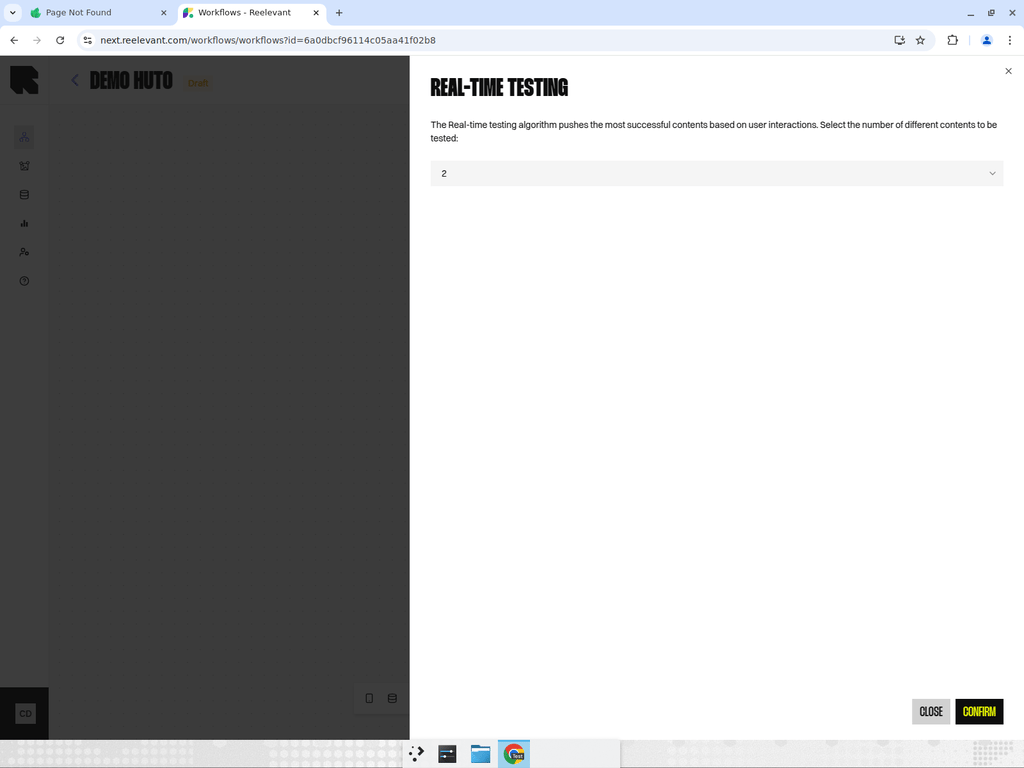
Overview
Real-time testing automatically distributes traffic across content variants and optimises allocation over time. Unlike a static Split, real-time testing uses a multi-armed bandit algorithm to shift traffic toward the best-performing variant.Configuration
The only setting is the number of variants (2 to 10). Select how many content paths you want to test using the dropdown. Each variant becomes a separate branch in the Workflow. There are no additional parameters to configure. The optimisation runs automatically once the Workflow is live.How It Works
- Traffic is initially distributed evenly across all variants.
- As users interact with each variant, the system collects performance data.
- The multi-armed bandit algorithm gradually shifts traffic toward higher-performing variants.
- Over time, the best variant receives the majority of traffic.
Unlike a fixed A/B test, real-time testing continuously adapts. There is no manual “end date” or “confidence threshold” to set — the algorithm balances exploration (testing underexposed variants) with exploitation (favouring winners) automatically.
Best Practices
- Use real-time testing when you want the system to find and favour the best-performing variant without manual intervention.
- Start with 2–3 variants for faster convergence. More variants require more traffic to identify a winner.
- Monitor results in the Workflow’s statistics mode to see how traffic is being distributed.
- Combine with branch categories to track variant performance in Analytics.